Recently, I had a conversation with one of my students, and it inspired the text that follows.
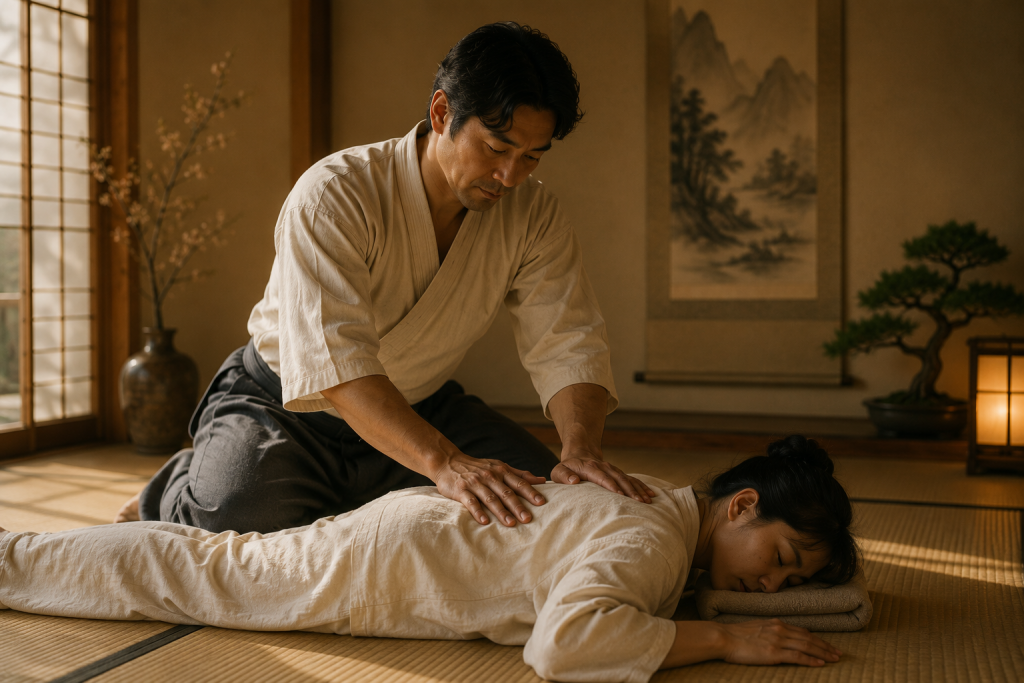
She had a fairly painful shoulder, but she still wanted to work because I was about to evaluate her technique. I simply told her, “Work on me as if you were working on yourself.” That was all. No secret techniques, no directed energy, no mystical explanations. Just work carefully and naturally, with the idea: “How would I want to be treated right now?”
At the end of the treatment, she told me something that did not surprise me at all: the pain had almost disappeared. Not because I had treated her shoulder, but because, without realizing it, she had begun to move and use her own body differently.
At first glance, it may seem difficult to explain, but situations like this are not uncommon in therapeutic practice. The explanation does not have to be sought in mysterious realms. The phenomenon can be understood quite logically through a combination of biomechanics, neurology, body awareness, and psychophysiological responses.
When a therapist works “as if working on themselves,” they often change, without realizing it, the way they use their own body. They become more aware of their posture, reduce unnecessary force, make better use of their body’s center, distribute their effort more efficiently, and stop compensating excessively through the shoulder. Many shoulder problems among therapists arise precisely from overuse and mechanical compensation.
As the body adopts a more economical and natural way of moving, muscular tension begins to decrease, defensive responses diminish, movements become smoother, and the muscles begin to relax. In practice, during treatment, the therapist begins to “reorganize” their own body without even realizing it.
Sometimes, therapists discover that it was not the technique itself that tired them the most, but the way they were using their own body. Perhaps this is one of the most valuable lessons that long-term practice can offer.
There is also a neurological aspect. Pain is not merely a signal indicating the presence of an injury or a structural problem. Very often, it is also a protective response of the nervous system. When the therapist becomes deeply engaged in the therapeutic process, attention shifts, concentration increases, a state of flow emerges, and the nervous system reduces secondary pain signals.
It is well established in neurophysiology that attention and the way we experience an action can modify pain perception.
The brain can reduce the perception of pain when the body functions efficiently, movement becomes coordinated, and a sense of control emerges.
Sometimes, the shoulder does not need complete immobilization, but rather good movement, circulation, graded loading, and proper coordination. During treatment, the therapist continuously mobilizes the joints, changes movement angles, activates the stabilizing muscles, breathes differently, and synchronizes movement with the trunk and pelvis. All of these can function as a form of active self-recovery. Sometimes pain results precisely from stiffness, fear of movement, or protective muscle guarding. As natural movement returns, excessive protection decreases.
There is also a very interesting phenomenon that frequently occurs in manual therapies. When you carefully treat another person’s body, your own nervous system enters a continuous process of adapting to the patient’s movements and responses. There is nothing mystical about it. The brain continuously builds an internal representation of the movement and muscular tension observed in the other person, and this influences, without our awareness, our own posture, breathing, and muscle tone. This is why an experienced therapist may sometimes feel the patient’s tension within their own body, unconsciously adjust their breathing, and modify their muscle tone according to the patient’s responses. By working “as they themselves would like to be treated,” they may naturally develop a better rhythm, better breathing, greater relaxation, and better body mechanics.
Many mild chronic pain conditions also have a component related to stress, fatigue, psychological tension, or nervous system overload. When the therapist enters an authentic working state, attention becomes organized, breathing stabilizes, the mind calms down, and a sense of coherence and purpose appears. All of these can reduce excessive protective muscle tone. That is why, after treatment, therapists sometimes feel better, more relaxed, and lighter in their own bodies. Not because they have “taken on” something from the patient, but because their own nervous system has temporarily come out of a defensive state.
The phenomenon can be understood as the result of the combination of all these mechanisms: better biomechanics, active therapeutic movement, nervous system regulation, reduced muscular protection, deep concentration, breathing, rhythm, better body organization, as well as emotional and autonomic adaptations.
Perhaps this is where the true meaning of the expression “Treat your patient as if you were treating yourself” lies. Sometimes, a good therapist does not heal only through what they do, but also through the way they learn to move, breathe, and organize themselves during treatment.
Experiment and observe what changes.
Sometimes, the best confirmation does not come from books, but from your own practice.
I look forward to hearing your observations.