In practice, things are never pure theory. There is no universal recipe and there are no fixed answers. There are different people, different bodies, different sensitivity thresholds and, above all, reactions that, over time, you learn to observe.
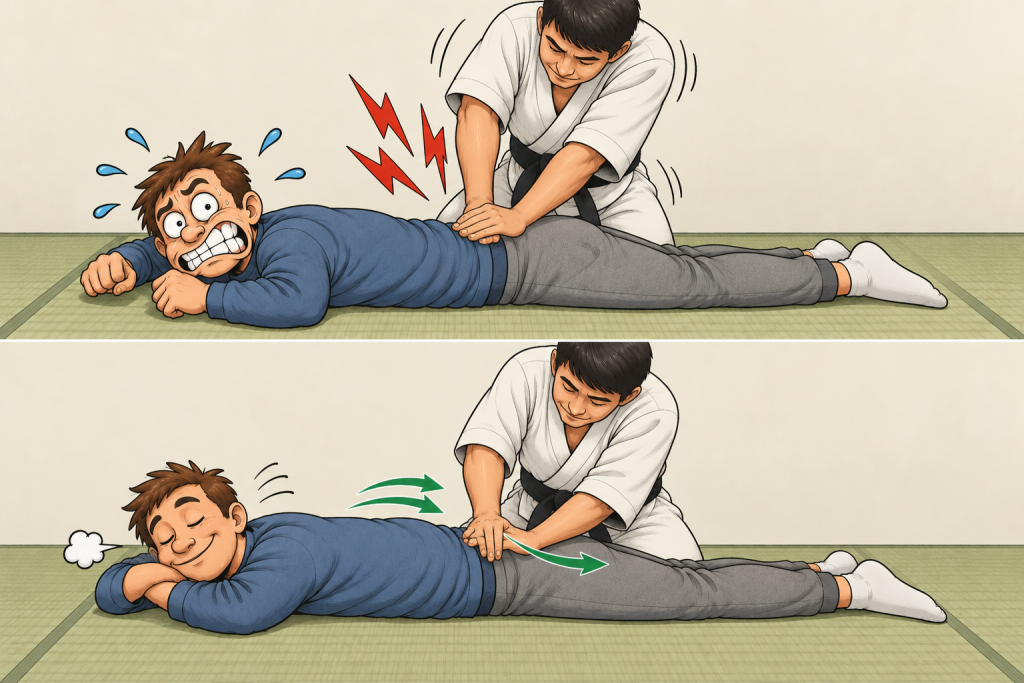
One of the things I hear quite often, especially from people who are used to strong massage, is: “You can press harder, I can take it.” Every time, I think the same thing: why should you have to “endure” a therapy? We are not in a pain-tolerance contest. And, after all, you do not even get a diploma for how much you endured.
I remember a client who, during his very first session, said exactly that to me after only a few minutes. I did the opposite of what he expected. I started gently and slowly, increasing the pressure gradually. At first he was a little puzzled. I even had the impression that he was waiting for me to finish the “warm-up” so the real session could begin. After a few minutes, however, his breathing changed, his shoulders dropped, and the tension I could feel under my hands began to decrease. I was able to work more deeply without suddenly increasing the intensity. At the end, he told me that the work had felt deeper than in other sessions he had experienced, even though it had not hurt.
That situation stayed with me. There is quite a difference between a client who endures pressure and one who accepts it without feeling the need to defend against it. You can grit your teeth and say that it is fine. That does not necessarily mean it is the right pressure.
I have noticed something else as well. When someone tells me “harder,” they are not always asking only for more pressure. Sometimes they want to feel that “something is being done.” If, for years, they have associated a good massage with a very intense sensation or even with pain, it is natural for a gentler approach to initially give them the impression that not much is happening. This is also where my role in explaining comes in, but without trying to convince the person that what they feel is wrong.
I have had clients who were so convinced that massage had to be strong that my explanations probably would not have changed much. At their request, although I was aware that this was not how I would have approached the area, I agreed for a few minutes to work the way they wanted. I did it deliberately, when the situation allowed it, so that they could compare. A few minutes the way they wanted, then the same area approached progressively, the way I would have done from the beginning.
Most of the time, the difference could be felt. With direct, intense pressure there was a tendency to tense up, sometimes the breathing became shorter, and I felt more resistance under my hands. I reduced the pressure, changed the rhythm and continued differently. After a few minutes I could increase the intensity again and, sometimes, go even deeper than before. The difference was that now the client no longer had to prove that they could “take it.” I could have explained all this from the beginning, but sometimes it is easier to feel the difference in your own body.
There is another very familiar phrase: “It hurts, but it is a good pain.” I do not automatically contradict it, but neither do I take it as permission to press even harder. I look at the person. If they tell me it is fine but hold their breath, clench their fists, lift one shoulder or subtly start moving away from my hand, I pay attention.
There is also the polite client. You ask, “Is it too much?” and they immediately answer, “No, no, it’s fine!”, even though you can see them gritting their teeth. Maybe they do not want to bother you. Maybe they think that is how it is supposed to be. Or maybe they simply want to prove that they can take it. That is why I ask. But I also watch.
Over time, I have learned not to confuse the intensity of the sensation with the effectiveness of what I am doing. The fact that the client feels a lot does not automatically mean that I am achieving more. Sometimes I reduce the pressure and things go better. At other times I can work quite deeply and the client is perfectly comfortable with it.
Because the opposite extreme does not seem right to me either. I am not saying that strong pressure is wrong and that we should always work gently. There are situations in which I work deeply and the pressure can become considerable. I simply do not see why I should necessarily start there. I can get there gradually, if what I feel under my hands and the client’s response allow it.
In the end, pressure is a tool, not the purpose of the intervention. If I become more concerned with how hard I am pressing than with why I am doing it, I risk losing the very meaning of the technique. Sometimes more pressure is needed, sometimes less. And sometimes it is more appropriate to change the technique, the position, or simply leave that area alone for the moment.
When I first make contact with an area, what I am really trying to do is find out what I am dealing with. I place my hand, begin to work and observe. I do not want to decide in advance how much pressure that person “should” be able to tolerate. It may sound a little poetic, but I like the idea that the hand asks before it decides.
I too have made the mistake of insisting. You feel a more tense area and the first impulse may be: let’s see if it gives way. Especially at the beginning, when you want to apply the techniques you have just learned as well as possible. At times I have gone into an area too quickly, insisted for a few seconds too long, or misjudged how much the client could tolerate. It happens. Experience does not make you infallible. I hope it helps you notice sooner that something is not working and change what you are doing.
Sometimes it is enough to reduce the pressure. Other times I change the rhythm, the position or the technique. And sometimes I give up what I intended to do. It took me some time to understand this too: the fact that I have started a technique does not oblige me to carry it through to the end. I have nothing to prove to an area that is becoming increasingly tense under my hand.
You can, in fact, perform a technique very correctly and still have it be unsuitable for that person at that moment. I think this is an important distinction. When you are learning, you are naturally concerned with placing your hands correctly, having the right position and reproducing as accurately as possible what you saw the instructor do. All of that matters. But then the real client appears, and things are no longer quite so simple.
I have also seen the temptation to copy the instructor’s pressure. It is normal. You watch the instructor work and try to reproduce everything. But pressure cannot be copied. Technique is learned, position is corrected, principles are passed on, but dosage has to be adapted to the person you are working with. The same technique applied to two different people does not necessarily mean the same pressure.
I also pay close attention to the first few minutes of the session. Before pressure, there is contact. The way you first place your hand on the client matters. If you go in abruptly, the person may react immediately. If the pressure comes on progressively, you give them time to understand what you are doing and to show you how they respond.
Breathing is one of the things I watch, but not the only one. Sometimes I hear the client inhale and then hold their breath. At other times I feel the abdomen tighten, one shoulder lift, a leg become rigid, or the body subtly begin to move away. I do not consider any one of these signs a verdict on its own. They are pieces of information that I consider alongside what I feel under my hands and what the client tells me.
And yes, we can simply ask: “Is it too much?”, “Is the pressure okay?”, “Do you feel that you have to tense up to tolerate it?” I do not think asking questions makes us less experienced. But I do not want to turn the session into an interrogation either. At the beginning I ask more, especially if I do not know the client. After that I observe, ask again when necessary, and also leave periods when I simply work.
Sometimes I stop for a few seconds after a technique. I do nothing spectacular. I simply observe what happens after the pressure is gone and, if appropriate, ask how it felt. I have learned that I do not have to fill every second with a maneuver.
Sensitive clients have taught me a great deal in this respect. They do not really allow you to work mechanically. Children, for example, are very direct. If they do not like something, you find out quickly. With older people, we also need to take into account tissue fragility, mobility, possible associated conditions, medication and general health. But sensitivity has no age. I have met young people who tolerated very little pressure and older people with whom I could work surprisingly deeply.
Not even the same client is identical from one session to the next. What felt very good last week may be too much today. Even within the same session, pressure that is unpleasant at the beginning may become perfectly tolerable later. And the opposite can happen as well. You cannot work on autopilot.
Over time, the way you look at your own hands changes too. At first you are very focused on technique. Then you begin to observe the person you are working with more closely. You feel that sometimes you can continue, while at other times you need to go back, change something or stop. For me, experience has not meant only accumulating techniques. It has also meant making these small adjustments more quickly.
Just as important is the way I use my own body. Deep pressure should not be a struggle for me either. Position, alignment and the use of body weight allow me to apply considerable pressure without turning every technique into an exercise in strength. In addition, when I am not struggling with the technique myself, I can pay more attention to what I feel under my hands.
And I do not have to achieve everything in a single session. That is another temptation I had at the beginning. Sometimes you can do more, sometimes less. Sometimes several sessions are needed before the client gains confidence and I come to know their reactions better. I do not see that as a failure. Quite simply, not everything has to be resolved today.
So, how hard should I press?
After years of practice, my answer is simpler than it was at the beginning: as much as the person in front of me allows and as much as is necessary for what I want to achieve.
I no longer believe that the value of a session lies in how much pressure I can apply or in how much pain the client can tolerate. Sometimes a little is needed, sometimes a lot. What matters is knowing why I am doing it and paying attention to what is happening while I do it. The client should not have to adapt to my pressure. I have to adapt the pressure to the client in front of me.
Perhaps the difference is clearest when the client no longer feels the need to say “I can take it,” but simply conveys to me:
“You can continue.”