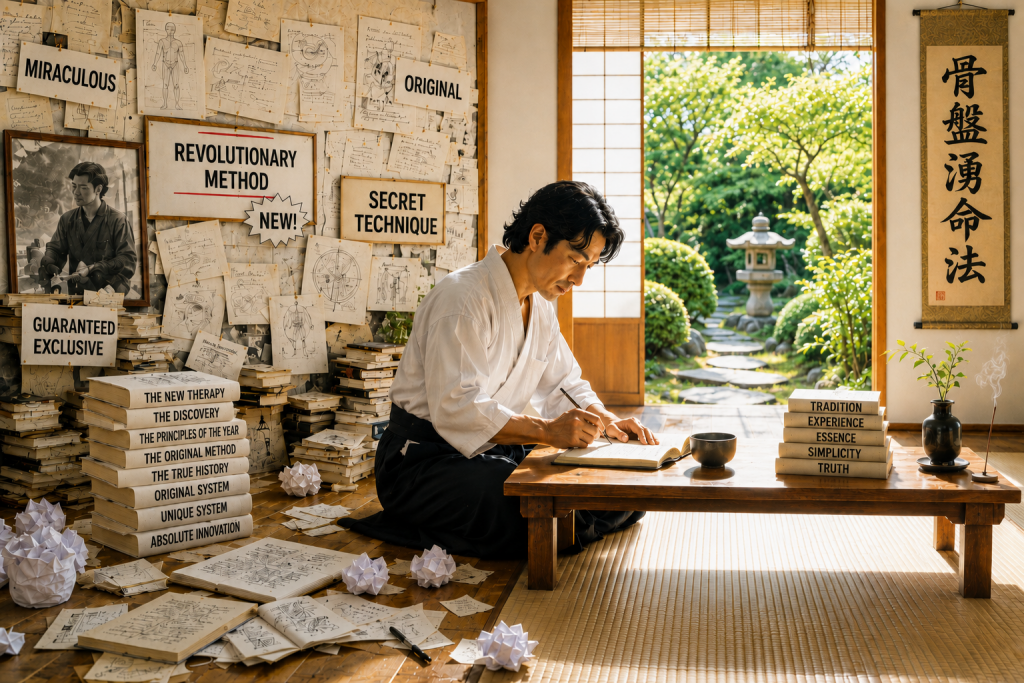
We live in a time when almost everything seems to have already been said, done, invented, or reinterpreted. Music resembles other music, films revisit the same themes, and books repeat the same human conflicts. Even people sometimes seem like replicas of one another: the same clothes, the same expressions, the same opinions, the same reactions.
This naturally raises a question: does authenticity still exist? Does originality still exist? Or are we simply recombining, endlessly, things that already exist?
The idea that “there is nothing new under the sun” is not new at all. It appears in Ecclesiastes, one of humanity’s oldest philosophical texts: “What has been will be again, what has been done will be done again; there is nothing new under the sun.”
And yet, paradoxically, every human being continues to feel the need to be unique.
Between Influence and Authenticity
If we look at things realistically, almost every human idea is built upon something that came before it. Language is given to us by others, and our thinking is shaped by family, culture, education, experiences, traumas, social models, algorithms, books, teachers, films, and conversations. Even our rebellions against society are often inspired by previous rebellions.
A musician uses notes that already exist. A writer uses words invented by others. An artist combines forms, colors, and emotions that humanity has explored for thousands of years. A therapist uses principles discovered by previous generations.
Absolute originality would require the emergence of an idea completely detached from any prior influence. That is almost impossible. The human brain works through association: it compares, combines, adapts, and transforms. It does not create from a vacuum.
Even the greatest discoveries were built upon earlier discoveries. Isaac Newton once said: “If I have seen further, it is by standing on the shoulders of giants.”
This does not mean a lack of value. Quite the contrary. It means that human beings are part of a continuous chain of consciousness, experience, and transmission.
So what is authenticity?
Authenticity does not mean being completely new. It means being sincere.
Here lies one of the greatest modern confusions: many people try to appear original, but very few try to be authentic. Originality can be performed. Authenticity is much harder.
You can adopt a different style, different clothes, a different vocabulary, or a different image. But authenticity appears only when what you say, what you do, and who you are inside begin to align with one another.
Authenticity means not living constantly for approval, not automatically copying what is popular, and not distorting your thoughts merely for social acceptance.
Paradoxically, authentic people are not obsessed with being unique. They are concerned with being real. And that is precisely what makes them unique.
We Are More Influenced Than We Think
Many people believe they think completely independently. In reality, a large part of what we call “our thoughts” consists of absorbed influences.
Family provides our first filters. School organizes the way we think. Society tells us what is acceptable. Advertising tells us what to desire. Algorithms tell us what to see. Social groups tell us what to approve of. Fear tells us what to avoid.
Most of the time, people do not even realize how much they are being “thought” from the outside.
This leads to a troubling question: do we think, or are we being thought?
Modern Algorithms and the Illusion of Total Freedom
Today, influence no longer comes only from family or society. It also comes from technology.
Digital platforms do not merely show us content. They shape our attention. If you see certain ideas every day, you begin to consider them normal. If you constantly see certain body types, behaviors, or opinions, they gradually become internal standards.
Many modern preferences are not entirely spontaneous. They are cultivated.
This does not mean that human beings no longer have freedom. It means that freedom requires awareness. A person who does not observe external influences may spend an entire lifetime convinced of being completely authentic, while mechanically repeating absorbed patterns.
Why Is It So Difficult to Be Authentic?
Because authenticity comes at a cost.
An authentic person risks being disliked, misunderstood, criticized, excluded from groups, or perceived as uncomfortable.
Human beings have a deep need for belonging, biologically, socially, and emotionally. As a result, many choose constant adaptation. They adjust their opinions according to the situation, change their personality depending on the group, hide their vulnerabilities, and build an image.
Not because they are bad people. But because they want to be accepted.
Authenticity requires courage because it means remaining yourself even when doing so brings no immediate advantages.
True Uniqueness Does Not Come from the Outside
Many people seek uniqueness in visible things: style, clothing, tattoos, exposure, or forced differentiation.
But deep uniqueness comes from the impossible-to-repeat combination of your experiences, your suffering, your memories, your way of feeling, and your way of interpreting the world.
Two people can learn the same technique, read the same book, and live in the same city. And yet they will become completely different individuals.
Why?
Because every consciousness filters reality in a unique way.
This is where true human originality emerges: not in the absolute invention of something new, but in the unrepeatable way each person lives and expresses existence.
Independent Thinking Begins with Doubt
Perhaps one of the most important signs of maturity is the moment when a person begins to ask:
“Is this thought really mine?”
“Where does this belief come from?”
“What would I have believed if I had been born into a different country, a different culture, a different family?”
These questions do not destroy identity. They refine it.
A person begins to notice the differences between what they feel and what they were taught to feel, between what they believe and what they were taught to believe.
Only then can a deeper form of authenticity begin.
Perhaps We Do Not Need to Be Completely Original
Perhaps the modern problem is that people confuse value with novelty.
Not everything valuable has to be new.
The sun has risen billions of times and still continues to inspire awe. A hug is not new. Neither is kindness. Nor love. Nor suffering. Nor the need for meaning.
Some things are repetitive precisely because they are fundamental.
Perhaps the purpose of life is not to invent something entirely unseen before. Perhaps the purpose is to become as aware as possible of who we are amid all the influences trying to define us.
Conclusion
Yes, probably very little is completely new under the sun.
We are built from influences, education, imitation, experiences, and preexisting models. To a certain extent, we are all “written” by the world around us.
But that does not cancel human uniqueness.
Because no one will ever combine exactly as you do your memories, your pain, your sensitivity, your way of loving, understanding, searching, falling, and rising again.
Authenticity does not mean the absence of influences. It means becoming aware of them.
And perhaps true originality does not lie in creating something entirely new, but in becoming, as sincerely as possible, who you truly are.