Over the years, I have met many people who were extremely skilled from a technical point of view. Practitioners who executed techniques flawlessly, who understood the body very well, and who achieved real results in their work. People you could learn from simply by watching them for a few minutes.
But at the same time, I noticed something important.
Not everyone who masters a technique very well is automatically able to pass it on to others.
And I believe this becomes especially visible in Yumeiho.
Because knowing how to do something is not the same as knowing how to teach someone else to do it.
There are practitioners who execute techniques flawlessly. They have precision, control, sensitivity, rhythm, and experience. Their body moves naturally through the technique, almost without hesitation. They instinctively know where to apply pressure, how to mobilize, when to change direction or intensity. For the patient, it seems simple. For those watching, it looks easy.
But the moment they have to explain to someone else what they are doing, how they are doing it, and why they are doing it, the real challenge begins.
Because teaching requires a completely different skill set.
It is not enough to master the technique. You must be able to break it down, explain it clearly, and adapt it so that the person in front of you can truly understand it. And that requires patience, observation, and the ability to enter another person’s learning process.
Very often, this difference becomes most visible during courses. There are people who work extraordinarily well on the mat but become rigid when they have to explain. And there are people who may not seem spectacular at first glance, yet students constantly grow around them because they manage to create clarity, confidence, and direction.
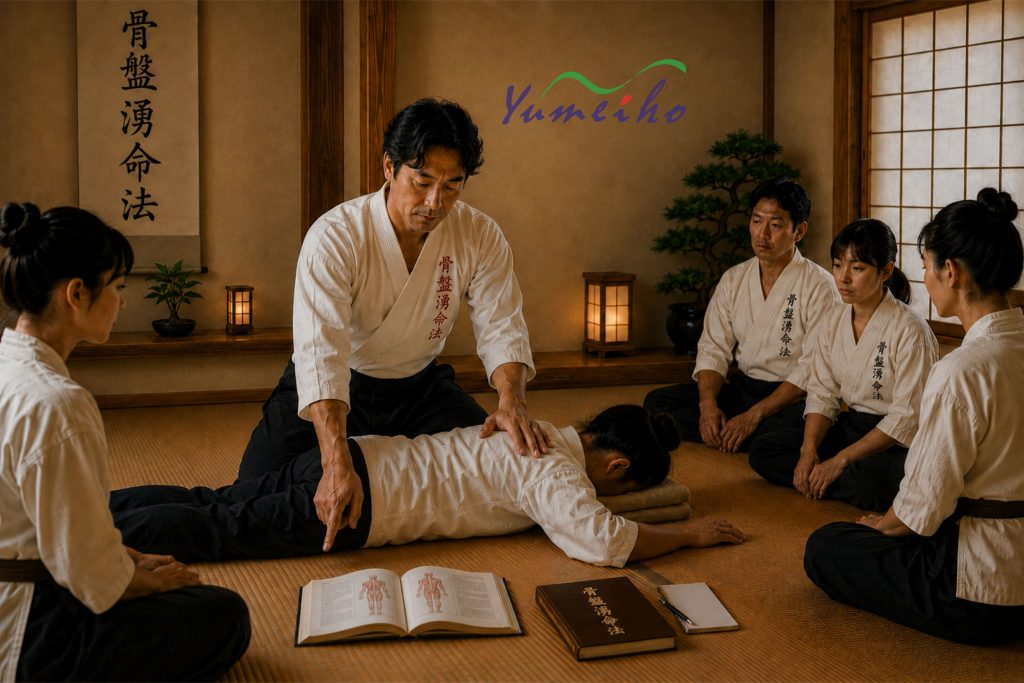
In Yumeiho, there are naturally several stages of development: practitioner, assistant, and instructor. Each stage has its own role and requires a different kind of maturity.
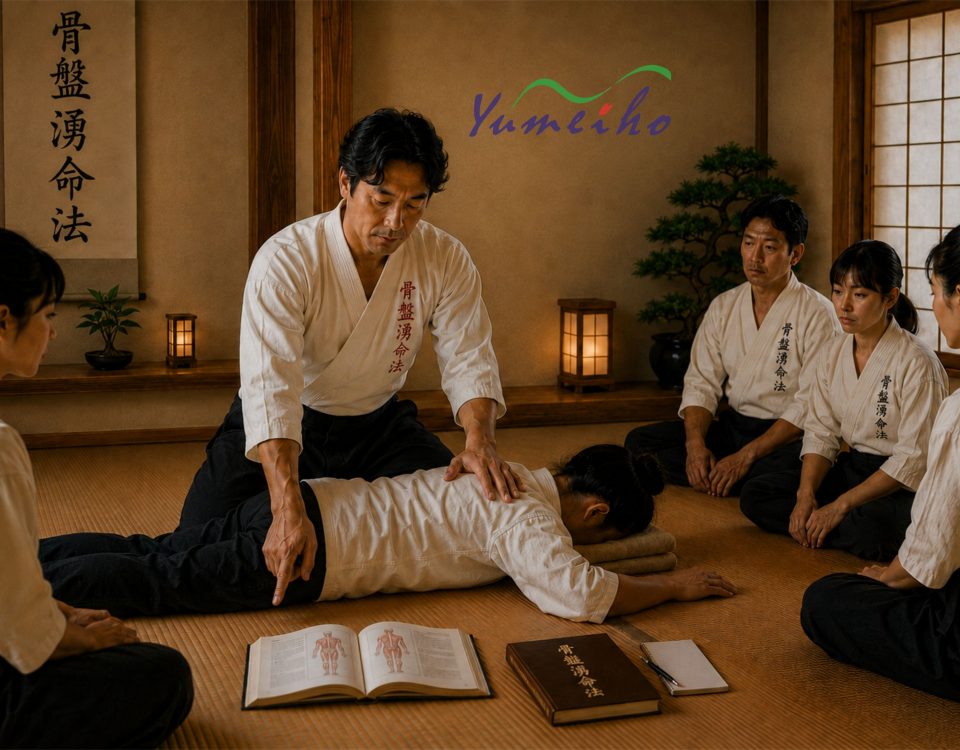
The practitioner learns execution. They develop posture, coordination, hand sensitivity, pressure control, and the logic behind movement. They begin to understand the human body through direct practice.
The assistant takes a different step forward. They are no longer focused only on their own execution but begin to notice the mistakes of others. They learn how to correct without blocking, explain without complicating, and support the learning process of less experienced colleagues.
The instructor, however, may have the most difficult role of all. Because a true instructor does not simply transmit techniques. They shape people.
They must know when a student is ready for a technique and when they are not. When immediate correction is necessary and when it is better to allow the body to discover the movement on its own. When the problem lies in the technique itself and when it comes from tension, lack of confidence, or fear of making mistakes.
This is where the difference appears between someone who only demonstrates and someone who truly knows how to develop others.
Many instructors teach exactly as they themselves were taught: demonstrate, repeat, correct. But very few truly know how to guide. Very few know how to adapt their explanation to the person standing in front of them.
Because every person has a different rhythm and a different way of understanding. Some learn visually. Others through repetition. Others need to feel the technique dozens of times before the body begins to understand it.
And perhaps that is exactly why, sometimes, the most spectacular practitioners do not necessarily become the best instructors. Their execution has become so natural that certain intermediate steps are no longer conscious to them. They instinctively do things that someone else is only beginning to discover, and precisely this automation sometimes makes explanation more difficult.
On the other hand, there are instructors who may not appear spectacular at first glance, yet manage to do something far more difficult: help people truly evolve.
And that has enormous value.
Because the purpose of an instructor is not to prove how good they are, but to make the person in front of them better than they were yesterday.
In Yumeiho, this becomes even more important because we work directly with the human body, with pain, with limitations, and with the trust that the patient places in the therapist.
A superficially trained practitioner may reproduce movements. But a properly trained practitioner begins to understand the body.
And this difference appears, most of the time, through the way they were guided along the path.
Perhaps the real question is not only who you train with.
But who truly helps you grow.
And if I were to summarize everything that defines the difference between a practitioner and an instructor, I would probably say this:
A good practitioner can change a patient’s life.
They can achieve excellent results through what they do directly, with their own hands, through their experience and technical level.
Their impact is real.
But for the most part, it stops with the people they personally treat.
A good instructor goes far beyond that.
They do not work only on one patient, but on all the people who will later be influenced by the students they train.
When you properly train a practitioner, the effect does not stop with that one person. Their way of working continues forward to tens, hundreds, or perhaps thousands of patients. And later, that practitioner may in turn become an assistant or an instructor and pass on the same foundation further.
That is where the idea of generations appears.
Not in the sense of age, but in the sense of professional continuity. A way of thinking, of approaching the body, of respecting the patient, and of understanding therapy.
A good instructor does not leave behind only information.
They leave behind people capable of building further.
That is why, sometimes, the greatest value of an instructor is not immediately visible in what they personally do, but in the quality of the people who grow around them.
Because a good practitioner creates results.
But a good instructor creates people who will continue creating results long after them.