In the journey of every Yumeiho practitioner, there is a threshold that profoundly changes the way therapy, the human body, and personal responsibility toward the patient are perceived: obtaining the 3rd degree, the level that certifies the status of therapist.
For many, this moment is seen as a validation of years of practice, learned techniques, and passed examinations. It feels like confirmation that “you know how to do Yumeiho.”
For others, however, there is a risk that this threshold becomes merely an external validation, a diploma that simply looks good on the wall.
And yet, the true value of this level does not lie in the diploma or the title itself, but in the transformation of the way one begins to understand therapy and the relationship with the person in front of them.
This level does not represent the end of learning, but the beginning of a completely different relationship with therapeutic practice.
Up to this point, the practitioner accumulates. They learn positions, sequences, corrections, postures, rhythms, working directions, and biomechanical principles. The body begins to adapt, the hands become steadier, and the techniques become clearer and more fluid. Everything seems built around the idea that effectiveness comes from correctly executing the method. And to a certain extent, this is true. Without a solid technical foundation, there can be no efficiency. But, much like a musician learning notes without yet understanding music, this stage represents only the alphabet of therapy.
The real change appears when the practitioner begins to understand that therapy is not merely the correct application of techniques. They discover the difference between “performing” and “treating.” They realize that two people with apparently the same problem may react completely differently to the same approach, and that a tense body cannot be forced into relaxation. True effectiveness does not come from intensity, but from the ability to adapt.
Patients are no longer perceived only through the lens of a technical pattern, but through their particularities: hidden tensions, nervous system reactions, fears, blockages, fatigue, or bodily sensitivity. From that moment on, Yumeiho begins to come alive.
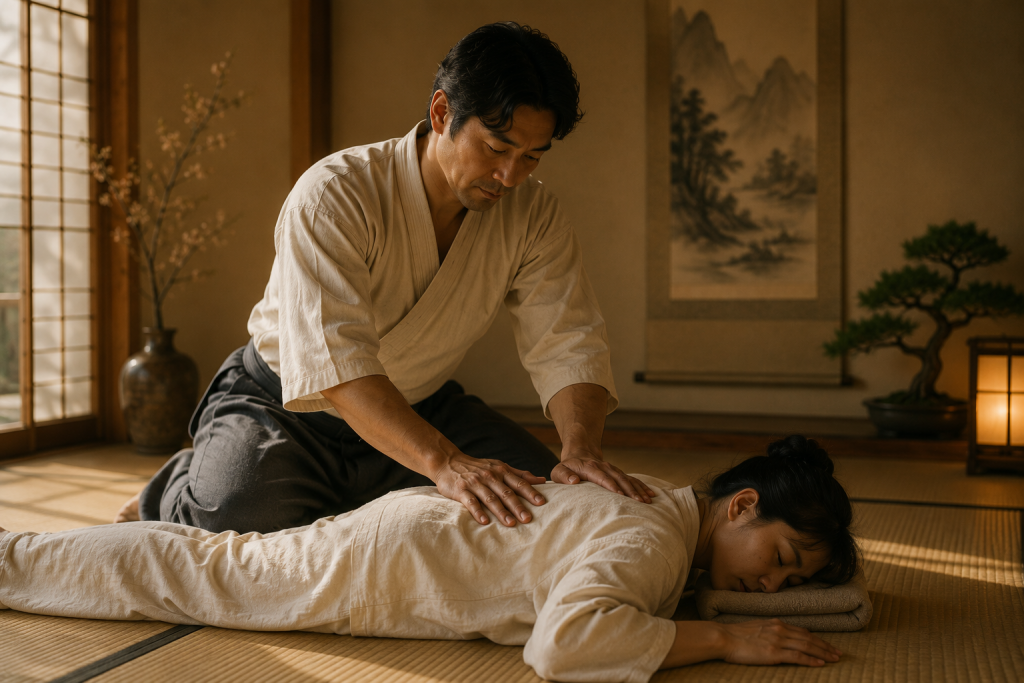
In Yumeiho, the difference between a practitioner and a therapist is not defined solely by the number of techniques known. The difference lies in the way the body is perceived. The practitioner often sees the technique. The therapist begins to see the person. They observe posture, breathing, unconscious protective patterns of the body, nervous system reactions, accumulated fatigue, fear of pain, or lack of trust.
Therapy ceases to be merely a sequence of maneuvers and begins to become a form of communication.
There is an essential difference between form and understanding. Form is what can be seen: the therapist’s position, the direction of the technique, the amplitude of mobilization, or the sequence of corrections. These can be imitated. Understanding, however, is what cannot immediately be seen: the ability to feel the body’s resistance, to adapt pressure, to create relaxation before intervention, and to know when to continue and when to stop.
Up to this threshold, the practitioner works mainly with form. Beyond it begins the true work on principles. Technique is no longer simply “executed,” but adapted. Pressure becomes more intelligent, rhythm more natural, and the intervention begins to take into account the reaction of the entire system, not just the painful area.
Many practitioners then discover that effective therapy is not necessarily spectacular. Sometimes, the most important changes appear through simple, precise, and well-measured gestures. The body does not always respond to force. More often, it responds to safety, continuity, and relaxation. At that point, the true flow in Yumeiho begins to emerge, that continuity of techniques in which the patient’s body no longer defends itself, but begins to cooperate.
This threshold also brings an inner transformation. In the early years, the desire to prove oneself often appears. The practitioner wants to perform well, to impress, to confirm mastery of the techniques. But real therapy does not function as a demonstration. The desire to impress, to show how much strength one has or how many techniques one masters, gradually becomes an obstacle.
The patient is not looking for spectacle. They are looking for safety, balance, and trust.
For this reason, this level also brings the responsibility of gradually letting go of rigidity and the need for affirmation through force or showmanship.
With this level also comes responsibility toward other practitioners. The therapist becomes, often without consciously seeking it, a reference point. The way they touch the patient, the way they relate to suffering, the calm they transmit, and the respect they show for the body’s limits often communicate more than any theoretical explanation.
Paradoxically, true evolution after this threshold does not lead toward increasingly complicated techniques, but toward simplicity. The therapist begins to rediscover fundamental things: personal posture, breathing, pelvic stability, the direction of pressure, continuity of movement, and the ability to work without unnecessary tension. The same techniques practiced for years begin to acquire a different meaning. Not because the techniques have changed, but because the understanding of the one performing them has changed.
In Yumeiho, there is no moment in which someone can truly say, “I know everything.” This level does not provide definitive conclusions, but opens a new stage of deepening. It is the threshold at which the practitioner begins to understand that true therapy does not mean control over the patient’s body, but the ability to collaborate with it.
Thus, the real significance of the 3rd degree does not lie solely in the official certification of therapist status. It lies in the transformation of the way therapy is perceived. It is the moment when the practitioner begins to understand that Yumeiho is not only about well-executed techniques, but about a profound relationship between knowledge, responsibility, presence, and respect for the human body.
And from that moment on, the true path of the therapist is only beginning.